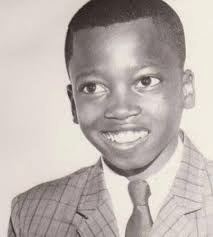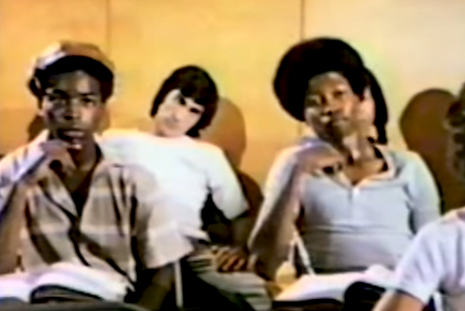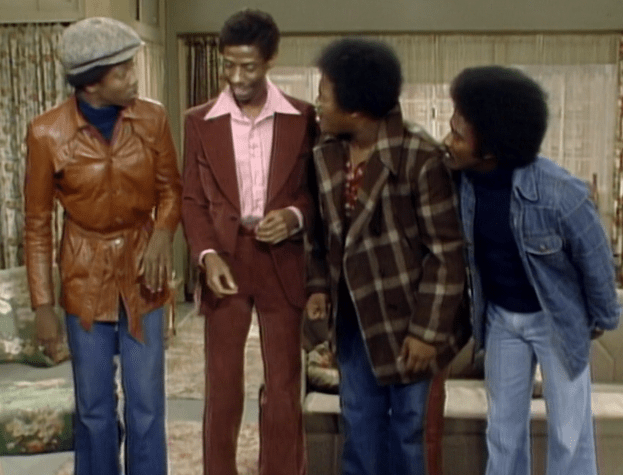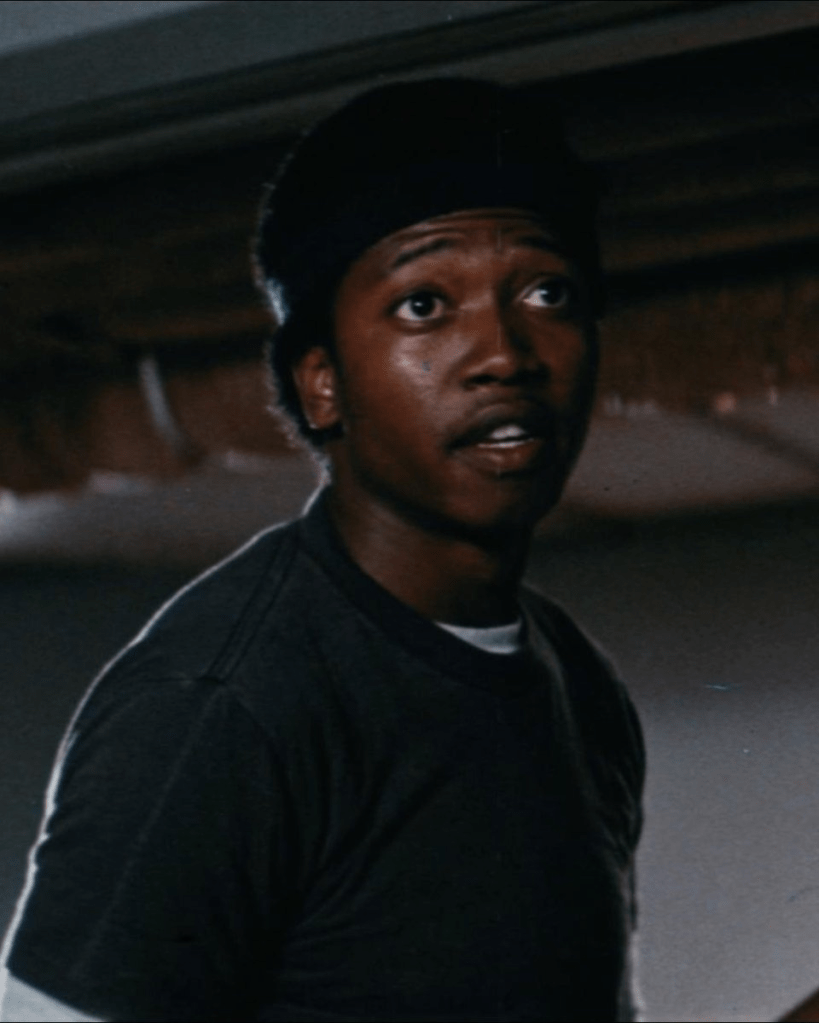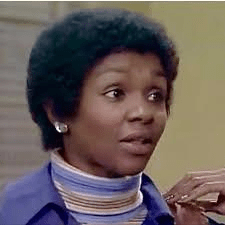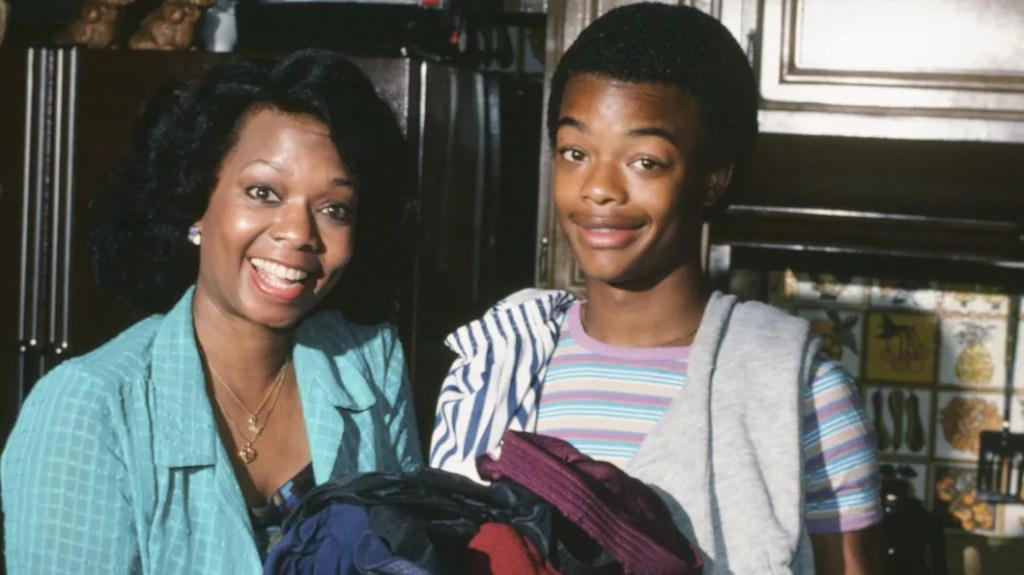

Happy birthday to Chip Fields, who turns 74 today! Perhaps best known for playing the abusive mother of Penny (Janet Jackson) on Good Times, Fields is the mother of actresses Kim and Alexis Fields.
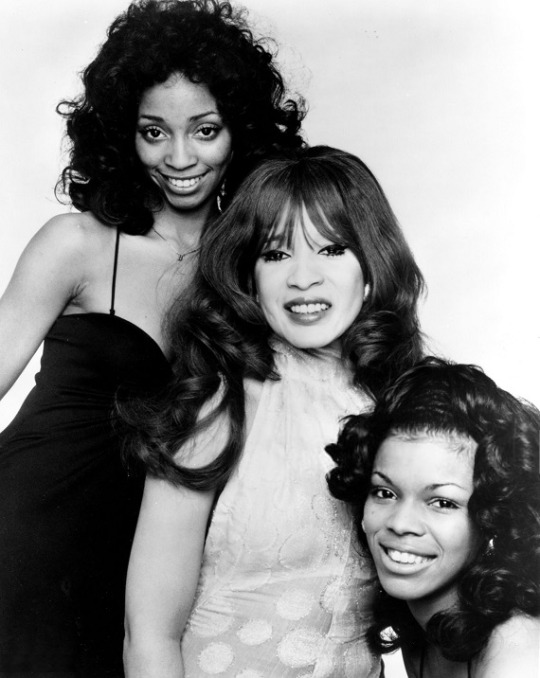
Born Laverne Fields in New York, the actress-director began her career as a singer; when Ronnie Spector reformed her group, The Ronettes, in 1973, Chip was one of the two singers selected to replace the two other originals, who did not return to the group. She recorded two songs with the group before it disbanded in 1975. Her acting debut came in the 1974 film Claudine, where she can be seen as an extra, and she later played an unwed mother on the NBC soaper Days of Our Lives.
Chip (lower right) as a member of Ronnie and the Ronettes.
Fields also played the mother of Regine (played by her real-life daughter Kim) on TV’s Living Single, and was seen in a variety of other shows, including What’s Happening!, Hill Street Blues, Roc, and The Wayans Brothers. In addition to her career in front of the camera, Fields was a dialogue coach for the film Menace II Society and directed episodes on a variety of television shows, including Girlfriends, The Parkers, One on One, and Hannah Montana.
In recent years, Fields directed numerous episodes of the Tyler Perry show Young Dylan, which ran on Nickelodeon from 2020 to April 2025. She and her husband, Erv Hurd, have been married since 1994.
Today we celebrate the actress Ta-Tanisha, who turns 72 today!
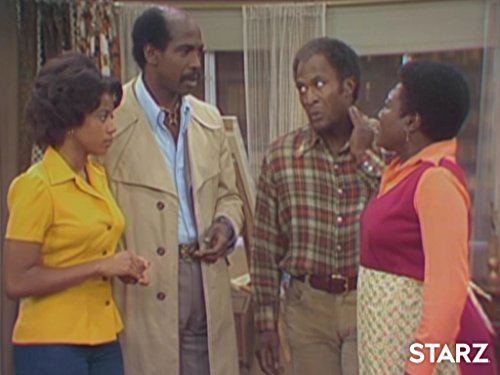
Born Shirley Cummings in the Bronx, Ta-Tanisha was seen in three episodes on Good Times, each time playing a different character.
The first was in Season One, Episode 13, “My Son, the Lover,” where she was Marcy. In this episode, she was the subject of one of J.J.’s paintings (and his ardor), but it turns out that she has a boyfriend (her “main man!”).
Next up, she was Mary Ann Thomas (“Sweet little Mary Ann Thomas,” according to Thelma) in “J.J. in Trouble,” which was Episode 21 in Season Three. Here, J.J. believes he’s contract a venereal disease from Mary Ann. And, finally, she played a small part in “J.J. and T.C.,” the 18th episode of Season Six, where she was the “Zodiac Girl” who J.J. tries to pick up in a bar.
More on Ta-Tanisha’s life and career can be found in my overview of her Season One appearance here. Meanwhile, I hope you’ll join me in wishing her a very happy birthday, and many more!
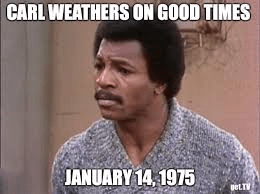
Weathers was seen on Good Times 50 years ago today, on his 27th birthday.
Today at “Ain’t We Lucky We Got ‘Em,” I’m paying tribute to actor Carl Weathers, who guested on “The Nude,” the 16th episode of Season 2. In this episode, J.J. is commissioned to paint a portrait of a resident of their housing complex, Charlene Brooks (Betty Bridges), also known as “The Wiggler.” As it turns out, Charlene wants J.J. to paint her in the nude (hence the episode’s title) as a birthday surprise for her husband, Calvin – played by Weathers – but a compromise is reached and J.J. paints her in a bathing suit. Nonetheless, when Calvin shows up at the Evans apartment, he misunderstands the situation and he’s not too happy, to say the least.
The episode, interestingly enough, first aired on January 14, 1975 – Carl Weathers’s 27th birthday – 50 years ago today.
During his days as an Oakland Raider. (courtesy of Marca.com)
A native of New Orleans, Lousiana, Weathers moved to California with his family when he was a high school student; as a teen, he demonstrated his interest in acting by performing in school plays, and he excelled in sports, including football, boxing, and wrestling. He attended San Diego State University, helping the football team win the 1969 Pasadena Bowl, and played professional football with the Oakland Raiders and the British Columbia Lions of the Canadian Football League. While he wasn’t busy on the football field, Weathers landed acting jobs as an extra and earned his Bachelor’s degree in drama from San Francisco State University.
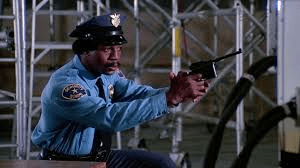
As a crooked cop in Friday Foster.
Weathers’s appearance on Good Times was his first acting credit, but he was a standout from the start and it didn’t take long for the handsome, muscular performer to begin racking up the gigs. His films included two 1975 blaxploitation films featuring Pam Grier and directed by Arthur Marks, Bucktown and Friday Foster. “My first love was acting,” Weathers said years later. “I went to Sidney Poitier films as a kid. I sat in the theater and dreamed of being an actor.”
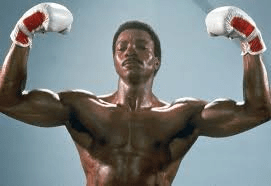
Weathers became an overnght star after appearing as Apollo Creed in Rocky.
The following year, he hit the jackpot when he was considered for the part of boxer Apollo Creed in Rocky (1976), written by and starring Sylvester Stallone. According to Weathers, he auditioned opposite Stallone, but after he finished, he said, “Wait a minute – if you can get me a real actor to read with, I can do this a lot better.” Amazingly, Weathers got the part, and he would go on to play Apollo Creed in Rocky as well as its three sequels.
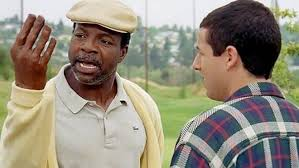
In later years, Weathers appeared in such well-known features as Predator (1987) with Arnold Schwarzenegger and Happy Gilmore (1996) starring Adam Sandler; in the latter, he played “Chubbs” Peterson, a golf pro who was forced to retire after his hand was bitten off by an alligator. He also starred in the title role of the action-comedy film, Action Jackson (1988), as an police detective in Detroit. His wide range of television roles over the years included appearances on shows from Kung Fu and Cannon, to Arrested Development and Chicago Justice, where he played the recurring role of State’s Attorney Mark Jefferies.
As “Chubbs” in Happy Gilmore.
In 2021, Weathers received an Emmy nomination for Guest Actor in a Drama Series for his role in the Star Wars series The Mandalorian (he lost to Courtney B. Vance in Lovecraft Country). He also did voiceover work on several video games including Mortal Kombat, and beginning in 1995, went behind the camera to serve as director on numerous television series such as Silk Stalkings, Chicago Med, Hawaii Five-O, and The Mandalorian.
Weathers died in his sleep on February 2, 2024, from atherosclerotic cardiovascular disease; he was 76 years old. After his death, his Happy Gilmore co-star Adam Sandler lauded him on Instagram, writing that Weathers was “a true great man. Great dad. Great actor. Great athlete. So much fun to be around always. Smart as hell. Loyal as hell. Funny as hell. Loved his sons more than anything. What a guy!! Everyone loved him.”
Later that year, in August of 2024, Weathers was posthumously honored with a star on the Hollywood Walk of Fame. His star was sponsored by his former football team, the Raiders (now housed in Las Vegas), and several family members were on hand, including his two sons, Matthew and Jason; his brother, Emanuel Weathers, III; and his longtime partner, Christine Kludjian. Other attendees included Bryce Dallas Howard, Ted Lange, and LeVar Burton, who told the crowd, “When you met Carl, you knew you were in the presence of somebody special.”
In honor of his birthday, we celebrate and honor Mr. Weathers today!
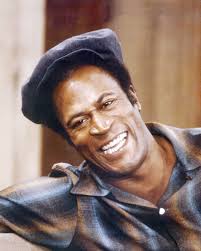
I was returning home after spending six glorious days in the Dominican Republic with a group of friends (who are like my family) that I’ve known since we met in the 1980s at Spelman College and Morehouse College. I was sitting at my gate at New York’s JFK airport, awaiting the boarding call and saving two seats for my travelling companions when I decided to pass the time on Twitter. The first post I saw was the announcement of the passing of John Amos at the age of 84.
You’d have thought, from my reaction, that it was my own father that I’d lost.
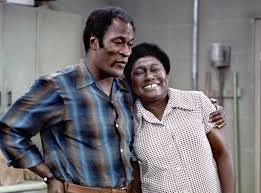
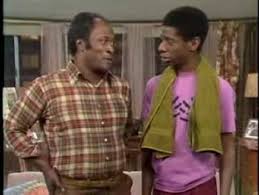
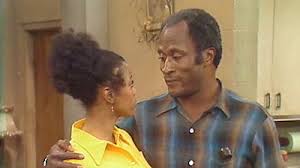
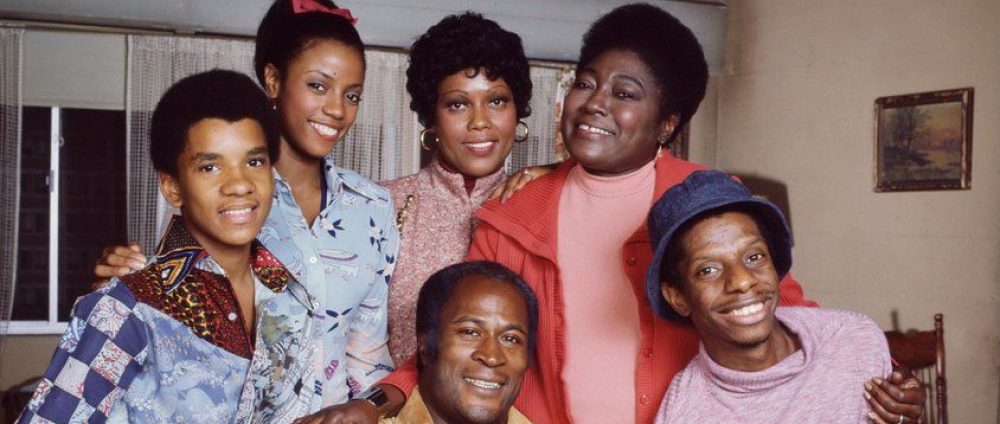
John Amos was known for such roles as Gordy on The Mary Tyler Moore Show, Admiral Percy Fitzwallace (how’s that for a name?) on The West Wing, Kunta Kinte on the 1970s mini-series Roots, and Cleo McDowell in Coming to America, but for me, he was and will always be James Evans on Good Times.
As I wrote when I first started this blog, I love Good Times. I own the series on DVD, I still watch the show daily, and I plan to eventually cover every episode on the pages of this blog. But I can’t deny that I generally focus my daily viewing on the first three seasons – and that’s solely because John Amos left the show at the end of season three. It goes without saying that Good Times wasn’t the same without him.
James Evans could be stubborn as a mule and inflexible as a wooden ruler, but he was a loving husband and a caring father who learned from his mistakes and wasn’t averse to admitting when he was wrong. He was compassionate and hardworking, sensitive and wise. He was affectionate, but he wouldn’t hestitate to go for his belt if the circumstance warranted it.
He was the kind of dad I wish I could have had.
As the actor who brought James to life and made him so beloved, John Amos was perfectly cast. He was equally adept at being funny, touching, and fearsome, and projected a natural authenticity that made him unforgettable as a father figure.
I am celebrating John Amos and James Evans today by watching my top five favorite Good Times episodes in which he’s featured. Here’s a bit about each of these, and why I love them so.
Sex and the Evans Family
As I wrote in a previous blog post, “Sex and the Evans Family” is my all-time favorite episode. It centers on the discovery of a book in the Evans household, titled “Sexual Behavior in the Ghetto.” Florida is appalled to find the publication in her home and blames J.J. for bringing it into the house; when he believes this contention, James is unconcerned and almost proud (“You dog, you,” he amusingly labels his son). But it’s a whole ‘nother story when James learns that Thelma is the responsible party.
John Amos’s abrupt transformation in this episode from delight to dismay is masterful. He also does a lovely job in conveying the special kind of love that fathers have for their daughters, injecting his performance with both poignancy and relatability.
The Check-Up
Because of his frequent headaches and hair-trigger temper, James’s family is concerned that he may be suffering from hypertension (“Or,” Florida translates, “as we plain folks say, ‘high blood pressure.'”). When James is finally convinced to get a check-up, he learns that he’s in good health, but he gets some important tips from the doctor.
Amos does a superb job in depicting James’s frustration and anger in this episode, especially in the scene where he insists that he’s not “nervous, sick, or upset.” He emphasizes this declaration by throwing a chair against the wall, demolishing it, then slamming the door to his bedroom with such force that it’s a wonder it stayed on the hinges. I’ve watched this scene countless times, and I still feel like I’m holding my breath, waiting for the worst to be over.
Thelma’s Young Man
Thelma has been receiving calls and going out on dates, but no one has met the young man who’s the object of her interest. When they finally do meet him, James is none too pleased to learn that Thelma’s “young man” is 42 years old.
Once again, Amos exhibits his versatility, showing his skill in comedy as well as dramatics. His reaction to learning the age of Thelma’s boyfriend is hilarious, as is his questioning Thelma about her reasons for wanting a quick wedding. And when he sits down with the boyfriend for a serious one-on-one, he makes us feel every bit of his combined vexation and concern.
J.J. and the Gang: Part 2
J.J. is reluctantly recruited into a gang run by a tough neighborhood dude by the name of “Mad Dog.” Although he tries everything to get out of participating in a rumble with a rival gang, J.J. is forced to go along and he’s shot by Mad Dog after the gang members encounter James and Florida in the street. The conclusion of the two-parter centers on James’s determination to see Mad Dog brought to justice for his crime.
Most of James’s actions and behaviors in this “very special episode” aren’t really played for laughs, although he does tote around a pocket full of prezels meant to represent Mad Dog’s trigger finger, and generates a giggle every time he snaps one in two. Instead, we’re treated to James’s struggle between his desire to avenge his son and his compassion for the fatherless young man who fired the gun. Amos himself considered this episode to be one of his most impactful.
The Weekend
To celebrate their 20-year wedding anniversary, James surprises Florida with a weekend in a mountain cabin. There’s not much of a plot; the action mainly deals with Florida’s worrying about leaving the children alone, and the sexy calendar girl, Gloria, who shows up at the cabin, having mistaken the date of her planned rendezvous with the owner.
Amos really shows his comedy chops here; he’s particularly funny after Gloria arrives – her seductive aura briefly throws him for a loop – and he’s even more nonplussed when Florida returns to the cabin after making a phone call, literally stuttering and stumbling over his words. And he balances this hilarity at the end of the episode, when his tender, romantic side emerges and we know, beyond question, what Florida sees in James.
It has always been a pleasure and a privilege to watch John Amos on Good Times. He brought so much to the show – so much humor, so much warmth, so much love. It’s no wonder that his absence was felt so acutely when he left the show. Fortunately for us, we can insert a DVD or turn on a cable channel, and see Amos’s James Evans whenever we want a laugh, or a cry, or even just an enthusiastic “right on!”
And for that, I’ll always be grateful.
What are some of your favorite John Amos episodes on Good Times? Let me know in the comments below!
If you’re a fan of Good Times — and, of course, you are! — you’ll remember the episode from Season 2 called The Nude, where J.J. is commissioned to paint a portrait of Charlene Brooks, a neighboring tenant known as “The Wiggler.” The actress playing Charlene was Betty Bridges, who enjoyed a 40-year film and television career; her appearance on Good Times was one of her first.
Betty Bridges and her son, Todd.
A native of Dallas, Betty was the mother of three children, including actor Todd Bridges, who started his career as a child actor and shot to superstardom with his role on the popular television series Diff’rent Strokes.
I’m sad to share that Betty Bridges died on August 27, 2024, at Todd’s home in Phoenix, where she had been in hospice care. She was 83 years old.
RIP, Betty Bridges.
After appearing on Good Times, Betty was seen on a wide variety of productions; she was seen in the 1998 film A Night at the Roxbury and her many small screen credits included Charlie’s Angels, NYPD Blue, Beverly Hills 90210, and Sister, Sister, as well as two appearances on Diff’rent Strokes. Her last performance was in 2014, on the comedy series Two Broke Girls.
My earnest condolences to the Bridges family. Betty’s appearance on Good Times was a standout. She won’t be forgotten.
Before I decided to create this blog, I’d planned to write a book on Good Times. In my (never-sent) book proposal from 2022, I mentioned the continuing popularity of the show as indicated by the numerous Facebook groups, and its ongoing relevance, evidenced by the then-upcoming animated series being developed by Norman Lear.
That animated series – called Good Times: Black Again – launched on Netflix on April 12th with a cast that includes Yvette Nicole Brown, Godfrey, Lil Rel Howery, Marsai Martin, Ego Nwodim, Rashida Olayiwola, Jay Pharoah, J.B. Smoove, Cree Sumner, and Wanda Sykes. Since it premiered, I’d seen numerous comments on Facebook, Twitter, and TikTok. Most were not favorable. And that’s putting it mildly. But I had to check it out for myself.
Bev and Reggie: Black Again.
The show’s pilot, entitled “Meet the Evans of New,” informs us of a few facts that I hadn’t previously known, primarily that the show is not a reimagining of the original although it does consist of a mother, a father, and three children – two boys and a girl – living in a Chicago housing project. But the father in Black Again – Reggie Evans – is actually the grandson of James and Florida Evans. This detail notwithstanding, the animated version resembles the original in several ways: the oldest son – Junior – is an artist and is not the sharpest knife in the drawer, academically speaking; Junior frequently squabbles with his sister, the middle child, whose name is Grey; and one of the children, who is an excellent student, also has a militant, politically aware persona. (The difference is that in the animated version, those characteristics are assigned to Grey, instead of the youngest child.) The animated Evans family also lives in the same apartment as the Good Times Evans: 17C; they even have the same triangle-shaped mirror and curtain-for-a-door closet in the front room.
After reading the comments on social media, I was primed to dislike the series, but I tried to keep an open mind. But to be honest, I was turned off by the opening title sequence! The new theme song is fine – it includes lyrics like, “Head above water, makin’ a way . . . Keep my family close, pick me up when I’m low, help me down on this road and I’ma bring us back home again . . .” But I didn’t care for the graphics, which included a close-up of a woman’s sizable rear sashaying down a city street and a baby with dyed blonde hair, a pacifier on a gold chain, and diamond earrings in each ear shooting craps on the street.
Before the babies start shooting. The BABIES.
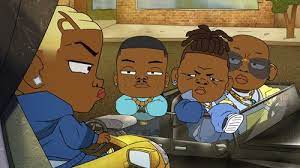
It turns out that the blonde-haired, earring-wearing tyke from the title sequence is Dalvin, the family’s youngest child – a drug-dealing baby who has been kicked out of the house by his father. When we first see him, he’s selling drugs from his stroller on a street corner. When a car full of rapper-babies pull up, insisting that he give up his corner, he refuses, and they actually start SHOOTING AT HIM. Later, he snorts powdered formula like it’s cocaine. And he keeps a gun in his diaper.
But I’m getting ahead of myself. Let me begin with the pilot’s very first scene, which shows Reggie Evans in the shower, warbling a few lines from the original show’s theme song. But it’s not a solo performance, y’all – it’s a duet. WITH. A. COCKROACH. It’s not a great start.
Dalvin. Enough said.
The plot of the pilot contains references to episodes from the original show – Junior paints a picture of Black Jesus on the living room wall, the mother – Beverly – is readying the apartment for the building’s beautification contest, and Reggie – attempting to raise money to help with his wife’s beautification efforts – takes his pool cue to the local billiard hall. (He refuses to take money from his drug-dealing baby and instead, takes Junior with him, saying, “I’m gonna show you how a man takes care of his family in a respectable way.”)
In the remainder of the episode, we meet Bev’s best friend, Lisa, who runs a beauty salon; Grey goes on a hunger strike to draw attention to the use of chemicals in food products; and Bev is told by Delphine, the head of the beautification judging committee, that the criteria has been expanded from previous years, and that they are taking a “more holistic approach.” (Incidentally, after this declaration, we cut to three scantily clad women clustered nearby; one of them says, “Y’all hear that, hoes? We got a shot to win.” And Delphine explains, “Not that kind of HOE-listic.” Hardee har har.) Because the beautification judges will now take “the family unit” into consideration, Bev prays to Black Jesus for the return of her son, Dalvin, to the fold, promising to get him baptized if he does. Before long, Dalvin does, indeed come back home – because he’s seeking sanctuary from the baby-rappers who are shooting at him.
Earning money at the pool hall. Respectably.
Meanwhile, in the pool hall, Reggie encounters a man – Minnesota Matt – whose grandfather lost his last $72 to James Evans in a pool game years before. It was all the money he had, his wife left him, and Matt wants a revenge rematch. This is another callback to the original series as, in the pilot of that show, the Evans family needed exactly $72 in order to avoid eviction from their home, and James Evans took to the local pool hall to get the money.
Let me try to wrap this thing up. Dalvin runs away from his mother (who, for some reason, was having him baptized in Lisa’s beauty salon) and gets picked up by the baby rapper shooters. Reggie is playing pool when he gets a call from Bev that Dalvin has been kidnapped and he leaves. Bev’s leaking boobs (because she’s still nursing) lead her to Dalvin and Reggie spanks the rapper babies with a belt, but one of them cuts the belt with a knife. Junior steps in with a broken pool cue and beats them all.
The family returns home too late to be considered in the contest, but Bev philosophizes, “I thought our family had to win this stupid contest to prove we were just as good as the Evans of old. Truth is, we’re the Evans of New.” (We have a title!) A short time later, Delphine returns, says her clock was wrong, and gives Bev the winning trophy. When she leaves, we see that she is being held at gunpoint by Dalvin, who also forces her to give him the keys to the building’s penthouse, where he intends to stay.
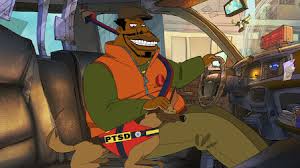
Reggie drives a cab. (That’s something, anyway.)
At the end of the episode, a safe falls through the ceiling, from Dalvin’s apartment onto the Evans’s dinner table, and Reggie closes things out with “Damn Damn Damn!” – the final homage (and I use the word loosely) to the original series.
I don’t want to belabor this thing, but I also checked out episodes two and three. Let me give y’all a few highlights (or lowlights, as the case may be):
We learn from Bev that Reggie’s favorites are takis, dark liquor, and Mexican corn on a stick wrapped with a chitlin.
Junior’s teacher (whose name, incidentally, is Mrs. Idontgiveashit) meets with Reggie and Bev because of Junior’s “lack of focus” in class. During the meeting, she’s smoking a cigarette and slurping from a flask.
This ain’t J.J. and Thelma, y’all.
Junior and Grey have a contest to see who will get the best grades on an upcoming test. The loser has to pick the roaches out of the cereal. Continuing with the roach theme, in another scene, Junior reminds his father that he’d told the children they couldn’t have a dog “because the roaches were our pets.”
Grey takes her exam and tells her parents: “The only person who can score higher on that test is Wendy Williams on Memorial Day weekend.” (I don’t even know what this means. I’m not sure I WANT to know what this means.)
Grey gets her period for the first time. When she and her mother see blood staining her pajamas, they both have the same reaction: “Please let her be shot!” Bev’s rationale is because now that she’s gotten her period, Grey can get pregnant.
Bev insists that Grey use sanitary napkins instead of tampons because “they’re a gateway. First tampons, then who knows what you’re sticking up there?”
At school, Grey stains her clothes and her mother shows up to help. They find that there are no sanitary napkins in the bathroom dispenser, and when Grey reaches for the tampons, Bev objects: “Read my lips. No tampons. Next thing you know, you’ll end up giving birth in a public restroom and your life as you know it will be over.” And THEN, we see the feet of a girl in a nearby stall and, as indicated by the closed captions, we get this:
[girl] Hey!
[water bubbling]
[baby crying]
And Bev says, “Well, if the stall fits!”
And that, for me, was the last straw. I couldn’t reach for the remote control fast enough.
I don’t even know where to begin to tell you how appalled I was by this show. Even if I wasn’t a huge fan of the original Good Times, I would be repulsed, but the fact that it serves to desecrate the name of a show that has such meaning for me – it’s just too much. I honestly cannot believe that this crap was allowed to reach the airwaves. And believe me, “crap” is putting it mildly.
No comment.
It seems that every few seconds, I was witnessing a ridiculously offensive sight or hearing an unbelievably insulting line. I don’t put anything past Seth MacFarlane – the brains (or whatever) behind shows like American Dad and Family Guy – but I’m really saddened to know that before his death last year at the age of 101, Norman Lear put his stamp of approval on this garbage. Maybe I shouldn’t be surprised. But what DOES surprise me is that NBA basketball star Stephen Curry, along with MacFarlane and Lear, was also an executive producer. Surely, he could have stepped up and had a say. Surely, he read the scripts and could have pulled out a red pen. Surely, he found SOMETHING about this series that left him feeling as disgusted as I was. But maybe the dollar signs provided a more salient inspiration than his conscience.
I know, from reading online comments, that there are those who think this series is funny, but I just can’t, y’all. I was far too offended.