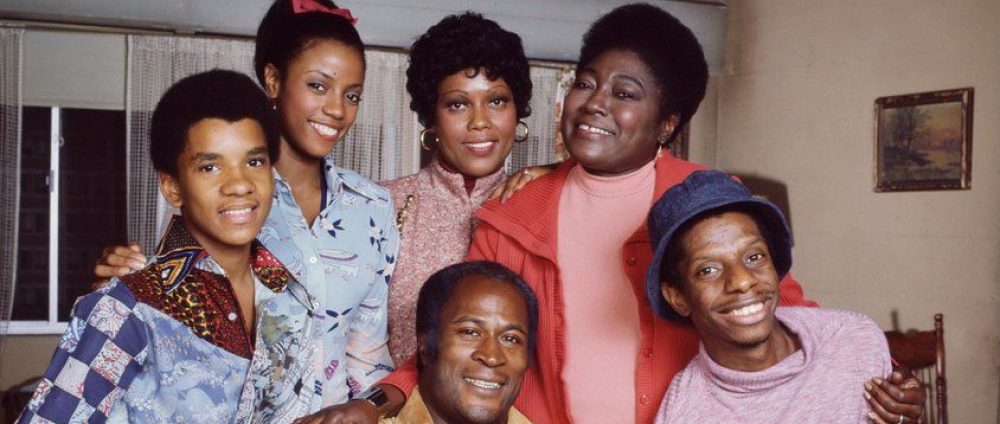

This episode is the second half of the series’ first two-parter; in Part 1, the family celebrated J.J.’s 18th birthday, which included his announcement of his new job as a courier, and his quickly masked disappointment when he learned his parents had been unable (due to a computer error) to buy the fancy art supplies he’d been expecting. And the episode ended when the family learned that J.J. had been arrested for trying to rob a liquor store.
As the second part begins, the family and Willona are arriving at the police station with hopes of securing J.J.’s release. They soon learn, however, that his bail has been set at $5,000 – which means a bond of $500 would be needed to get him out. Meanwhile, J.J. not only faces a “good cop, bad cop” interrogation session, but he’s then put into a cell with a brutish criminal characterized by his ability to bend a spoon with one hand and his penchant for appropriating J.J.’s meals.
Just as Florida and James consider borrowing the bond money from a loan shark (at 20 percent – per WEEK), they’re told that the real culprit has been found and that J.J. is being set free. But the family’s celebration is short-lived – after visiting J.J.’s new boss to offer an excuse for his absence, Thelma learned that the manager already knew about the arrest and that J.J. has lost his job. And in a final twist of irony, the Evans family gets a glimpse of the real robber of the liquor store – a short, rotund youth with a large, unruly afro. “I can see how you made a mistake,” Florida facetiously tells the arresting officer. “They’re practically twins.”

As I stated in my previous post, I didn’t find Part 1 of this two-parter to be a laugh-riot, but Part 2 more than made up for it; this episode is practically overflowing with humorous lines and exchanges. The first comes just a minute or so after the episode begins, when Florida keeps interrupting James to talk to the desk sergeant, despite James’s insistence on handling the situation. And then, when Thelma speaks up as well, Florida commands her to be quiet, adding, “Let your daddy do the talking!” There are laugh-out-loud moments throughout, but the episode still manages to sneak in several somber situations, using humor to highlight the reality of false arrest and the increasing encroachment of computers on the lives of law-abiding citizens.
Pop Culture Connections
Certs
When J.J. is asked by the cops why he was in the liquor store, he tells them he had a date and stopped in to buy some Certs. He then adds, “You know – click, click?” and makes a gesture with his two index fingers. Certs was a popular breath mint that debuted in 1956 and was one of the first breath mint to be marketed nationwide. A small disc with green flecks, Certs was advertised as “two mints in one,” because it was both a breath mint and a “candy” mint. Interestingly, it didn’t contain oil from a mint plant but, instead, was made with a substance known as “retsyn,” which was a mixture of partially hydrogenated cottonseed oil, copper gluconate, and flavoring. The mint’s green flecks were a result of the copper gluconate.
Certs was discontinued in 2018, reportedly due to the product’s use of the hydrogenated oil; this substance is no longer allowed in foods sold in the U.S. because of its connection with heart disease. However, the product has been revamped and made a reappearance at the Sweets and Snacks Expo, held in Indianapolis, Indiana, in May 2025.
J.J.’s gesture with his fingers and his comment, “click, click,” refers to the advertising for Certs and its “two mints in one” concept. You can see what I mean in the commercial below.
Mrs. Olson
Willona brings Florida and James a thermos of coffee that she made, but it’s so distasteful that James quips that it could help secure J.J.’s release – a few drops could burn a hole in the jail. Willona responds that she “never said that [she] was Mrs. Olson.” Mrs. Olson was the name of the pitchwoman for Folgers Coffee, played by actress Virginia Christine. More on Mrs. Olson and Virginia Christine can be found in my post on Episode 11 from Season 1.
Supp-Hose
When J.J. is being questioned by the two detectives, one of them mentions that the liquor store robber had a nylon stocking over his face. J.J. responds that this proves his innocence: “Where would I get a nylon stocking from?” he asks. “My sister wears panty hose and my mother wears Supp-hose!” Supp-hose was a line of support stockings developed in 1956 by the Kayser-Roth company. They were designed to improve blood circulation and reduce swelling in the legs, but Supp-hose strived to be more glamorous and less utilitarian; the advertisements for the product claimed that they were the sheerest support hose on the market and showed them being worn by a stylish model in a fur coat.
Guest Stars:
This episode had more guest stars with speaking parts than any to date!
James Greene (Desk sergeant)
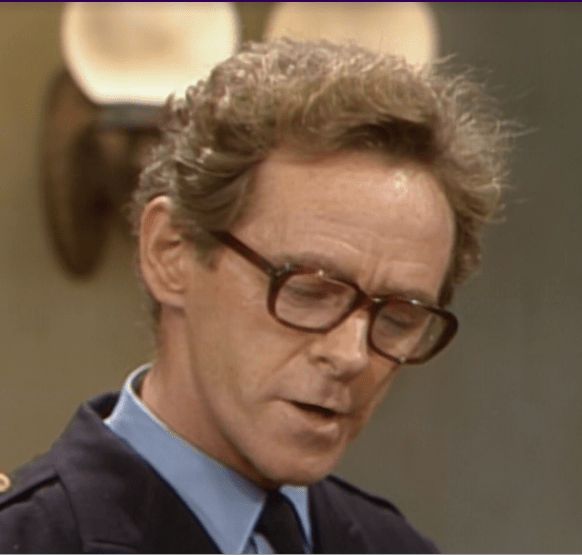
Born James Thomas Nolan in Lawrence, Massachusetts in 1926, Greene made his Broadway debut in the chorus of the 1951 production of Romeo and Juliet, starring Olivia de Havilland. He went on to appear in 22 Broadway plays and 29 off-Broadway productions; these included The Iceman Cometh in 1985, where he co-starred with Jason Robards. After appearing in his first feature film in 1961, he had roles in pictures including Ghost Story (1981), which featured classic film stars Fred Astaire, Melvyn Douglas, and Douglas Fairbanks, Jr., and The Road to Perdition (2002), a Depression-era thriller starring Tom Hanks. He was most prolific on the small screen, however, with guest spots on a variety of shows and recurring parts on the Days and Nights of Molly Dodd, where he played the elevator operator, and Parks and Recreation, where he was seen as a city councilman. Greene continued working until the year he died, 2018, at the age of 91; his final appearance was on the TV series Break a Hip, starring Christina Pickles (who won an Emmy for her performance).
Mel Stewart (Davis)
Stewart was born in Cleveland, Ohio, and started acting with a community theater there when he was a teenager. He later moved to New York, appearing in such Broadway productions as Simply Heavenly, written by Langston Hughes, and Purlie Victorious, where he was the understudy for characters played by Ossie Davis and Godfrey Cambridge. Stewart was also an accomplished musician, playing the tenor saxophone with such greats as John Coltrane and Charlie Parker; he was proficient on the piano and the flute as well.

After moving to California in the 1960s, Stewart joined an improv group and eventually caught the attention of Hollywood; in one of his earliest feature film appearances, he played an elevator operator in Odds Against Tomorrow (1959), a gritty noir produced by Harry Belafonte. Some of his other films included Nothing But a Man (1964), starring Ivan Dixon, and The Landlord (1970), directed by Hal Ashby. On the small screen, he was seen in recurring roles in several shows including Car 54, Where Are You?, Roll Out, Tabitha, and Scarecrow and Mrs. King. He also played Henry Jefferson, the brother of Sherman Hemsley’s George, on All in the Family.
Stewart’s talents included work behind the camera – he directed two episodes of the series Get Christie Love, starring Teresa Graves, as well as plays at the Black Repertory Theater in Berkeley, California, and San Francisco’s Center for African and African-American Art and Culture. He also served as an acting teacher at San Francisco State University, where one of his students was Danny Glover, and while at the university, Stewart established a theater group called Black Actors Now Through Unity (BANTU). And apart from acting, Stewart held a third-degree black belt in aikido and operated a martial arts school for inner-city young people in San Francisco.
After appearing in the film Made in America in 1993, Stewart retired from acting, reportedly stating that there were “too many black bald actors in Hollywood.” He died of Alzheimer’s disease in 2002 at the age of 72.
Ron Masak (Sloane)
Chicago native Ron Masak was born in 1936; his mother, a merchandise buyer, was of Irish descent and his father, a salesmen and musician, was of Czech Bohemian descent – and his first cousins are Michael Gross from TV’s Family Ties and Mary Gross from Saturday Night Live. Masak grew up on the city’s south side and was a graduate of Chicago’s Kelly High School. According to the actor, he turned down a contract from the Chicago White Sox; instead, he made his acting debut in Stalag 17, produced by Chicago’s Drama Guild in 1954, and studied theater at Chicago City College. He also served as a military policeman in the U.S. Army and toured the world doing vocal impressions in an Army production called Rolling Along.

One of Masak’s first TV appearances was on The Twilight Zone in 1960, when he played the “Harmonica Man” in Season 1, Episode 19, “The Purple Testament.” His feature film debut came near the end of the decade, in Ice Station Zebra (1968), where he joined a cast that included Rock Hudson, Ernest Borgnine, and Lloyd Nolan. During the next several decades, Masak appeared on nearly 100 television series, but he’s probably best remembered as Cabot Cove Sheriff Mort Metzger on the popular Angela Lansbury series, Murder, She Wrote, which he played for the final eight years of the show.
Masak was also a frequent guest on numerous game shows, including Match Game and Password, served for eight years as the Los Angeles host for the Jerry Lewis Telethon, and for 15 years was the pitchman for Vlasic pickles, voicing the animated stork who sounded like Groucho Marx. He also did ads for numerous other products including Rice-a-Roni, Glad sandwich bags, Spray and Wash, and Ford automobiles, and was once dubbed “King of the Commercials.” Masak died of natural causes in 2022, at the age of 86.
Stan Haze (Prisoner)
Haze was born Stanley Hazlip in Pittsburgh, Pennsylvania, in 1938. His career started, according to the actor, by accident. He was living in Chicago in the early 1970s and took his son to a swimming class at a local community center. A play was being performed at the center, the production was in need of a soldier, and Haze was asked to step in. “I told them I had never acted before and they said, ‘Don’t worry – all you have to do is shoot this lady with a machine gun,’” Haze said in an interview with the Los Angeles Times. “It was my first live performance. The reviews panned the show, the lead actor quit, and the production was going to shut down. I had memorized all his lines and asked the producer to give me a shot. I ended up playing the lead.”
Haze went on to take three years of classical training and in 1973, he made his TV debut playing a mugger in the made-for-TV movie, The Blue Knight. He appeared on Good Times the following year and later guested on numerous TV series, including The Odd Couple, Sanford and Son, Hill Street Blues, and Amen, as well as the blockbuster mini-series, Roots. He was also in feature films like From Noon Till Three (1976), a western starring Charles Bronson and his wife, Jill Ireland, and the hit 1990 comedy, House Party.

In addition to his film and TV appearances, Haze had an affinity for Shakespeare; in 1977, he was seen at L.A.’s Gryphon Theater in an updated version of Macbeth, and in 1980, he produced, directed, and starred in Othello at the 5th Street Theater in Los Angeles. Some of his other stage work included Porgy and Bess, The Great White Hope, and Carousel. In 1981, he teamed with San Diego developer John Bancroft to lease and remodel a clothing store in Glendale, California, and transform it in the Glendale Academy of Performing Arts. Haze and Bancroft planned to provide classes in dance and acting, produce plays, offer a showcase where aspiring actors could perform in front of industry representatives, and videotape productions for sale to cable television. (I regret that I’ve been unable to find out what happened with this project.)
By the 1990s, Haze’s TV career was behind him, but he did appear in a few films and continued his stage work as well, including a 1995 production of Othello and Desdemona at the Globe Playhouse in West Hollywood that he adapted, directed, and starred in. Sadly, in 1999, at the age of 60, Haze died of lung cancer.
Cal Wilson (Loan Shark)
Unfortunately, I haven’t yet been able to find a lot of information on Cal Wilson that I could confirm; I found some anonymously submitted information on the Internet Movie Database, but until or unless it can be corroborated, I simply don’t feel comfortable sharing it here.
I did, however, find two newspaper articles from the early 1970s about a couple of TV specials that listed Cal Wilson as a member of the cast: “Changing Scene,” a musical variety special on ABC in 1971, and The Jerry Reed When You’re Hot, You’re Hot Hour from 1972. That’s about it – but I’m determined to unearth more about this talented actor, and I’ll update this page when I do!
Connie Sawyer (Personnel Woman)

Born Rosie Cohen in Colorado in 1912, Sawyer began her career as a stand-up comedian in vaudeville and later earned the nickname, “The Clown Princess of Comedy.” She debuted on Broadway in a 1948 musical review called Hilarities, but it closed after only 14 performances. She didn’t get her big break until nearly a decade later, when she was a standout in the Broadway production of A Hole in the Head in 1957. Frank Sinatra later bought the film rights, and two years later, Sawyer made her big screen debut in the feature film, reprising her role from the play.
Sawyer went on to appear in a variety of movies and TV shows over the next six decades. Her films included True Grit (1969), Bob & Carol & Ted & Alice (1969), Oh, God! (1977), Dumb and Dumber (1994), and Out of Sight (1998). And on the small screen, she was seen on more than 100 shows, from Armstrong Circle Theater in the 1950s to Ray Donovan, where she made her final appearance in 2014. Sawyer published her memoir in 2017, called I Never Wanted to Be a Star – And I Wasn’t; the following year, she died at the age of 105.
Other Stuff:
The $500 bond that the family would have had to cough up in order to get J.J. out of jail would be worth approximately $3,200 today.
Incidentally, in 2023, Illinois became the first U.S. state to abolish the system of putting up money in exchange for release after an arrest. The release of arrested individuals now focuses on the seriousness of the charges against them, and on whether they’re considered to be a flight risk or a danger to the public.

This episode gives us James’s first use of the word “nigga.” He utters it to the loan shark after learning his interest rate for a loan, asking, “Nigga, is you sick?” It’s always startling to hear, because by no stretch of the imagination would this ever be used in a TV sitcom today.
This episode also gives us yet another reference to J.J.’s habit of petty thievery that had been introduced (and, mercifully, dropped) in the first season. Here, Florida tells James that she hopes J.J.’s experience with the arrest will teach him “not to make a joke out of finding things.”
One of these days, I’m going to find out why this two-parter was filmed under the name “J.J. Gets Arrested,” but is now called “J.J. Becomes a Man.”
The next episode: Crosstown Buses Run All Day, Doodah, Doodah . . .


 Ain't We Lucky We Got 'Em?