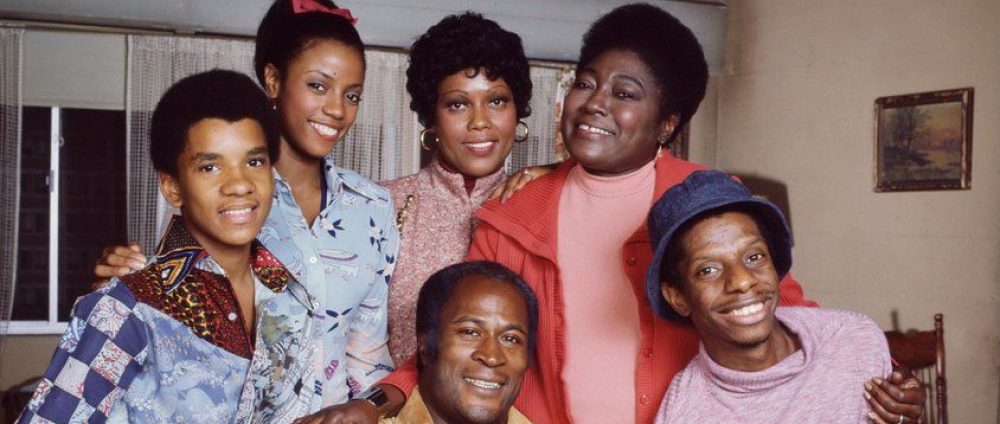
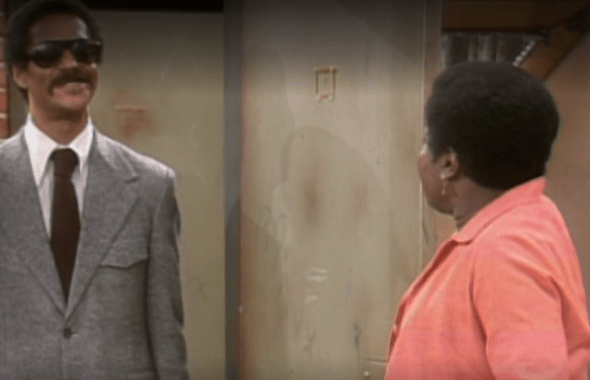
This episode of Good Times opens with information that is crucial to the plot – the phone in the Evans’s apartment is disconnected due to non-payment of the bill. In fact, James is out trying to drum up some work so that he can have it turned back on. But this isn’t the episode’s focus. That honor – as indicated by the title – comes in the form of one Henry Anderson, a door-to-door salesman who arrives at the Evans’s abode selling a set of encyclopedias about Black history (which actually sounds pretty awesome). Despite Florida’s objections, Anderson finesses his way into the apartment, but it’s not until he trips over a chair that the family realizes that he is blind, and Florida’s attitude softens.
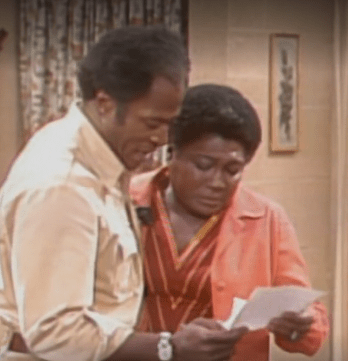
When James arrives home, he’s convinced by his enthusiastic children to purchase the set of encyclopedias and he signs a contract for an “easy payment plan” of $5 down and $2 a week. It’s not until later that the fine print on the contract reveals a series of additional charges including, as James observes, a “final balloon payment that’s going to blow us away!” James begins to suspect that Anderson is faking his disability, but after the salesman produces proof that he was injured in the Korean War, the family appeals to him to help them get out of the contract. Anderson – assuring them that he was unaware of the extra charges – insists on contacting his boss, and before James and Florida can stop him, Anderson is feigning a call to his employer, unaware that the telephone isn’t in working order. After he hangs up, Florida fakes a call of her own – to the police – and warns Anderson that he has 60 seconds before she turns him over to the authorities. He tears up the contract, returns James’s $5 down payment, and is informed that the phone is disconnected – so he was “out-conned” by Florida.
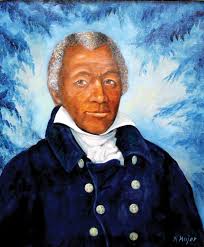
With its multi-layers, this episode is one of my favorites. I like the way the writers used the encyclopedia premise to point out the accomplishments of Black people, which included noting artists such as Charles White, Ernie Barnes, and Henry O. Tanner, and singers and writers like James Baldwin, Lorraine Hansberry, Marion Anderson, Leontyne Price, and Paul Robeson, as well as historical figures like James Amistead, a Revolutionary War spy. I also appreciated the messaging about the capabilities of individuals with disabilities, and the way the episode stressed that they shouldn’t be treated differently from anyone else (as both Florida and James do when they learn that Anderson is blind). The episode even goes so far as to show that people with disabilities can also be flawed; or, as Anderson says before his exit, “Blind people are just like everybody else – you take the good with the bad.”
Laugh-Out-Loud Moments
In addition to the points I mentioned above, I also found this episode to contain an abundance of memorably funny lines. Here are some of my favorites:
Shortly after Anderson enters the Evans’s apartment and trips over the chair, Michael says in a loud whisper, “Mama, he’s B-L-I-N-D!” And J.J. responds, “But, Michael, he can still H-E-A-R.”
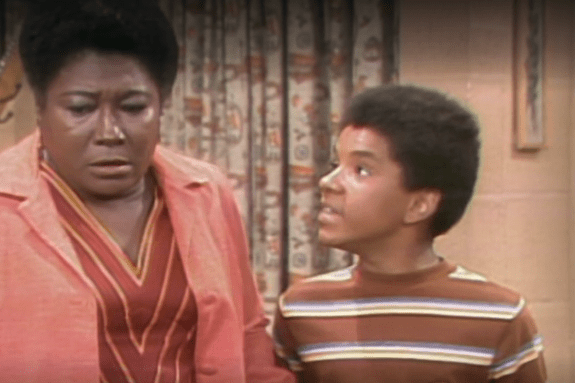
Later, when Anderson trips a second time, it’s James’s reaction that makes me laugh: “Now, what kind o’ clumsy ox y’all done brought in here? Knocking over furniture, stumbling and bumbling around? How you expect somebody to buy something you selling . . .” And then when Thelma cuts him off, telling her father that Mr. Anderson is blind, James’s face instantly takes on a mask of contriteness and he does a complete about-face, apologizing profusely and directing Thelma to get Anderson another cup of coffee.
In trying to convince James to buy the encyclopedias, J.J. tells his father that the set covers everything “from slavery to Shaft. From tote that barge, lift that bale, to, ‘Get your hands off me, honky!’”
When James tells JJ to lay down in front of the door to prove that Mr. Anderson can see, J.J. vehemently objects, insisting, “I ain’t layin’ down on no floor!” James looks genuinely puzzled and simply says, “I beg your pardon?” – and J.J. quickly responds, “I was just laying down on the floor.”
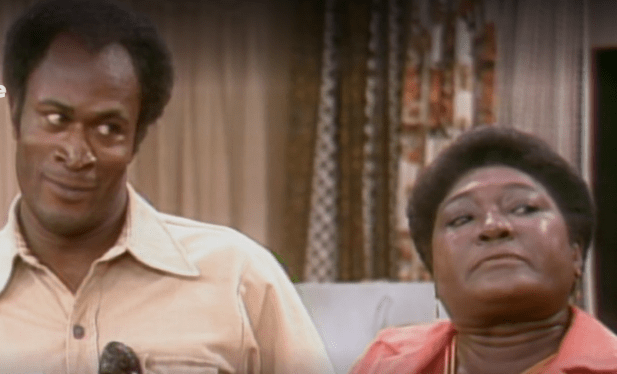
One of my laughs doesn’t come from the delivery of a line, but simply the look on James’s face when he realizes that Anderson is making a fake phone call and is clearly a “no good, phony hustler.”
And moments later, James asks Anderson if he can read Braille. When Anderson answers in the affirmative, James places Anderson’s hand over his fist and says, “Good. What do this say?” (Gets me every time.)
Pop Culture References:
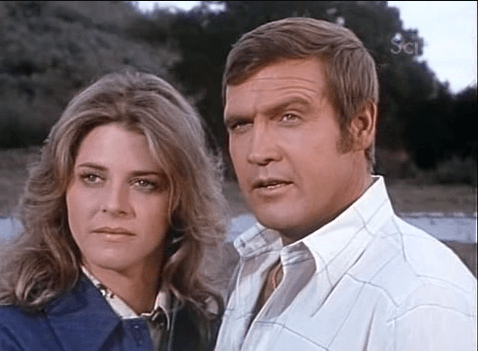
Shortly after Anderson arrives on the scene, he not only deduces that J.J. is tall and handsome, but also an artist. J.J. is amazed, and remarks, “Boy, this guy’s got the Six Million Dollar Man beat by five million dollars!” The Six Million Dollar Man was a television series that aired on ABC-TV for five years, from 1973 to 1978. Starring Lee Majors in the title role and produced by Aaron Spelling, the premise was that Majors’s character, astronaut Steve Austin, was severely injured during a test flight and was “rebuilt” using bionic materials that gave him herculean strength, speed, and vision. (By definition, bionic means the replacement or enhancement of body parts like organs or limbs with electronic or electromechanical devices.) Austin uses these newfound abilities to work as a secret agent for a government agency. The show also gave rise to a spin-off: The Bionic Woman, starring Lindsay Wagner as Jamie Sommers, Austin’s former fiancée, whose body was rebuilt after a sky-diving accident.
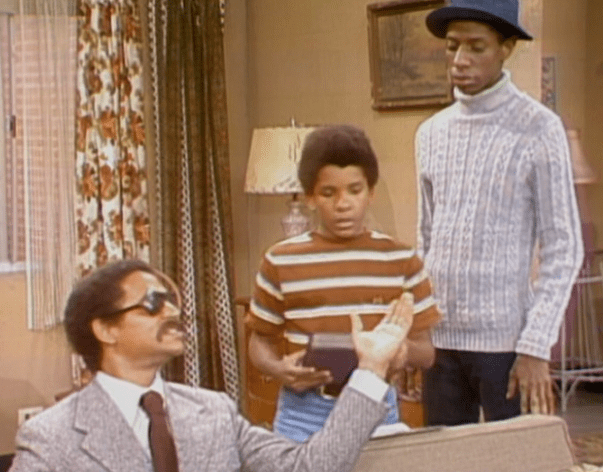
When Mr. Anderson asks Michael for the volume of the encyclopedias that he’d been reviewing (“Michael, may I have the book, please?”), James comments, “Well, will you listen to Mr. Siddity!” Also spelled “saditty,” “sadiddy,” or “saddity,” this term was commonly used in Black culture to refer to someone who was conceited, full of themselves, or “stuck-up.”
About halfway through the episode, after enjoying a good dinner, James remarks that if the family isn’t able to get out of the contract with Anderson, “this table is gonna be down to poke and grits.” When Michael asks about the meaning of the phrase, James explains, “That’s when you ain’t got nothin’ to eat, you poke out your lips and grit your teeth.” I’d personally never heard this saying before this episode, but it was apparently popularized in the South, which makes sense, as the character of James Evans was raised in Mississippi.
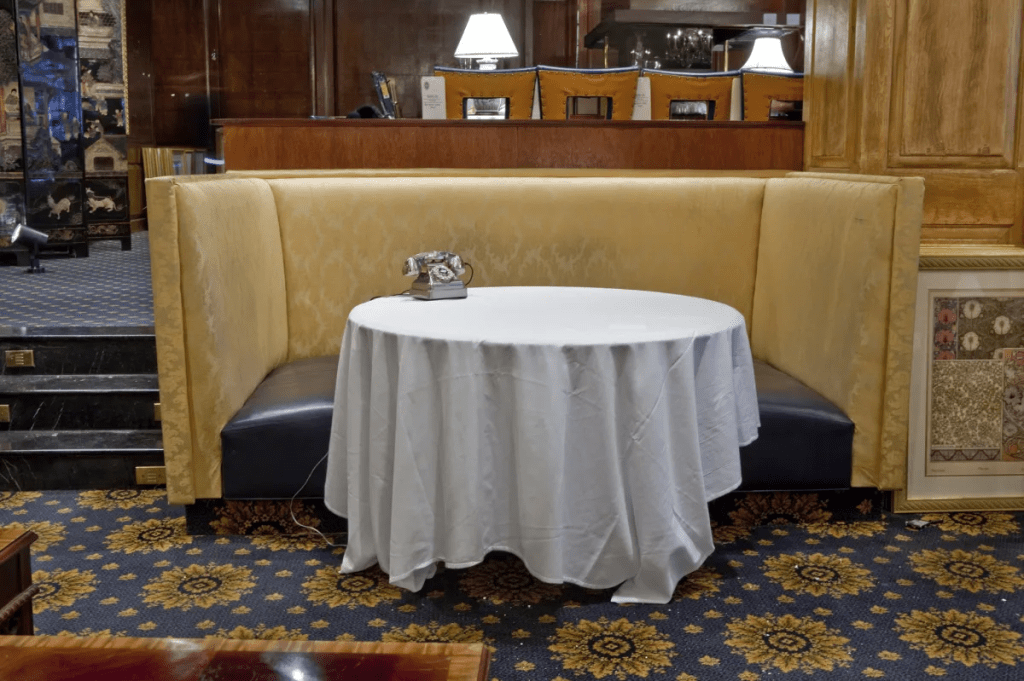
For the second time in the series, the Ambassador East hotel was mentioned; this time, it was when J.J. suggested that the family deal with the encyclopedia contract dilemma by packing their belongings and staying at the hotel “until this thing blows over.” For more about the Ambassador East, click here to see the Pop Culture section in my coverage of Season One, Episode Three.
When Florida makes her faux phone call to the police, she asks for the Bunco Squad. This was a special police division that was responsible for investigating con games, forgery, fraud, and other swindles. The term “bunco” originated in the 1800s – it was an illegal dice and card game and gambling dens – known as “bunco parlors” – in cities like Chicago and San Francisco were frequently raided by the authorities. The units assigned to these illegal parlors became known as “bunco squads.” Eventually, the name fell out of fashion, and these special police units are now commonly referred to as Fraud Units or Financial Crimes divisions.
Guest Star:
Mr. Anderson was played by Ron Glass, who may be best known for his role as Det. Sgt. Ron Harris on all eight seasons of TV’s popular police comedy, Barney Miller. In 1982, he earned a Primetime Emmy nomination for the role.
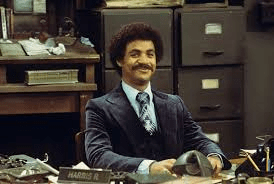
Glass was born in Evansville, Indiana, on July 10, 1945. He excelled at academics, winning a spelling bee while he was in elementary school, and he demonstrated a talent for athletics and singing at St. Francis Seminary in Cincinnati. In 1968, he earned his Bachelor of Arts degree in drama and literature from the University of Evansville, and later that year, he made his professional stage debut at the Guthrie Theatre in Minneapolis, Minnesota. A few years later, he moved to Hollywood, landing his first television role on Season 2, Episode 6 of Sanford and Son, where he played a card sharp named Hucklebuck. Glass went on to make guest appearances in numerous TV shows over the years, from All in the Family, Maude, and Hawaii Five-O, to Agents of S.H.I.E.L.D. (one of the all-time favorite shows of my younger daughter, Jessica), Friends, and CSI: NY. He also played featured roles in several films, including the 2008 feature Lakeview Terrace, starring Samuel L. Jackson.
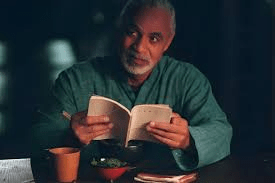
After playing the dapper, would-be author on Barney Miller, Glass played Felix Unger in a reboot of The Odd Couple, co-starring Demond Wilson (of Sanford and Son fame) as Oscar Madison. Unfortunately, the series only lasted a year. Glass would also be remembered for portraying Shepherd Derrial Book on the TV series Firefly and the follow-up film, Serenity. He played his final television role on CSI: Crime Scene Investigation in 2014.
Outside of his career as an actor, Glass was active with a variety of organizations and institutions. He served on Board of Trustees at the University of Evansville; the American Repertory Dance Company, and St. Thomas University; honorary chair of the African American Museum of Evansville; and chairman of the Al Wooten, Jr. Heritage Center in Los Angeles, California. And in a 2005 interview with The History Makers, he indicated that his favorite vacation spot was the South Seas, his favorite season was spring, and his favorite food was grits.
Glass died of respiratory failure in 2016. He was 71 years old.
Other stuff:
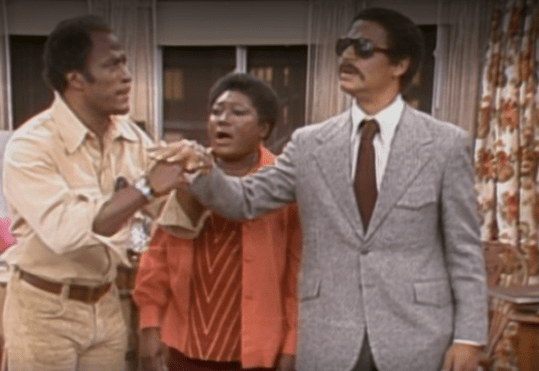
Once again, Florida’s alleged weight problem is used for laughs. After Anderson says he can tell that Florida is kind, warm, youthful, and charming, she offers him a cup of coffee – and adds that it’s her way of thanking him for not mentioning her weight. (Oy.)
The next episode: Crosstown Buses Run All Day, Doodah, Doodah . . .
(You may have noticed that my episode coverage is slightly out of order. Instead of writing about Episode 6 – Crosstown Buses – for my current post, I misread the number as an 8 and covered the Encyclopedia Hustle instead. Guess it’s time to get new reading glasses!)
 Ain't We Lucky We Got 'Em?